
How to Determine Your Dogs Calorie Requirements and Energy Factor
If you look up how much to feed your dog, you will likely be given lots of different answers ranging from a percentage of their weight based on energy levels to a generic number of cups to feed based on their weight. What these methods fail to take into account are your dogs calorie requirements and the caloric density of the diet itself. Depending on the diet, you can be feeding anywhere from 30 calories per ounce all the way to 70 calories per ounce or more! Knowing how many calories your dog needs to eat can reduce the chance of any unwanted weight gain or loss from switching to a homemade diet.
The most accurate way to determine your dogs energy factor is to use the calories they are already consuming. If you are feeding a commercial diet, you should be able to calculate how many calories they are eating per day fairly easily. Here are 3 examples: 1 for an exclusively kibble fed dog, 1 for an exclusively (commercial) raw fed dog and 1 for a dog eating half kibble and half canned.
NOTE 1: While most foods do share calorie information, it is not required by AAFCO to include this on the packaging. It is possible to estimate calories if you have the macronutrient levels (protein, carbohydrate and fat) but it is more difficult to do and more in depth than I will be going into in this post.
NOTE 2: This is only applicable for dogs at an optimal weight
NOTE 3: Knowing your dogs energy factor is not something that is super important. In this case, it is used to determine which downloadable recipes to purchase so that your dog is eating a balanced diet.
Kibble Fed Dog
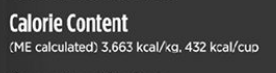
As you can see, this food has a calorie content of 432kcal/cup. This statement is typically found on the back of the bag near the Nutritional Adequacy Statement but it can be all over the place. If you have trouble finding it, most manufacturers make it much easier to find on the website.
Once you have found the calorie content of the food, we need to know how many cups of the food your dog eats per day. For this example, we’ll use a 50lb dog who eats 3 cups of kibble per day. To determine the daily calorie intake, multiply 2.5 (cups of kibble per day) by 432 (this kibbles calorie content). The total will be 1296 calories per day. Now, take that number and input it in the calculator below to determine energy factor. In this example, the dogs energy factor is 124.
Commercial Raw Fed Dog
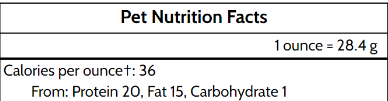
Raw foods tend to give calorie information in ounces. For smaller dogs who eat less than a pound, owners are likely feeding based on ounces but for larger dogs, we often work in pounds so an additional conversion has to be done.
For this example, we’ll use a 75lb dog who eats 2lbs of this raw food per day. In order to calculate the total calories, we need to convert 2lbs to ounces. There are 16oz in 1lb so multiply 2 by 16 to get a total of 32oz. Now, just multiply 32oz by 36kcal/oz to get 1152 calories per day.
If you’re following along, you’ll notice that this dog is eating fewer calories than the 50lb dog from above even though he is 15lbs heavier. This is totally normal and exactly why generic feeding recommendations for homemade food shouldn’t be followed. This 75lb dog has an energy factor of 81.
Half Kibble, half canned fed
Mixing foods just adds 1 more step to calculating calories because you need to calculate each separately and then combine them. For this example, we’ll use the same dog from the kibble example except now he’s eating 1.5 cups of kibble and 1.5 cans of wet food per day.
Like before, multiply 1.5 cups of kibble by 432kcal/cup to get 648 calories from the kibble. Then, multiply 1.25 cans by 489kcal/can to get 611 calories from the canned food. When these are added together, the total calories per day is 1249.

What If I Don't Know My Dogs Current Caloric Intake?
In the unlikely situation where you don’t have any information on how many calories your dog is consuming on a daily basis, you can use energy factors to make an educated guess. Choose somewhere in this range based on your dogs activity levels.
80-95: Sedentary to very low activity levels. These dogs are typically referred to as “easy keepers” Most middle-aged and senior dogs or active dogs with lower metabolisms will fall within this range.
95-110: Younger or unaltered dogs typically fall within this range. Middle-aged or senior dogs that still have active lifestyles would also fall within this range.
110-130: Working dogs and young adult dogs typically fall within this range
From here, you can use the following calculator to get an estimate of how many calories your dog needs per day. Since this is an estimate, if you know your dogs calorie requirements, you may be surprised by the energy factor after reading the “classifications.” Your young adult dog that is fairly active may still fall within the 80-95 range and that’s nothing to worry about! This is why understanding their calorie requirements is much more beneficial!